Primates
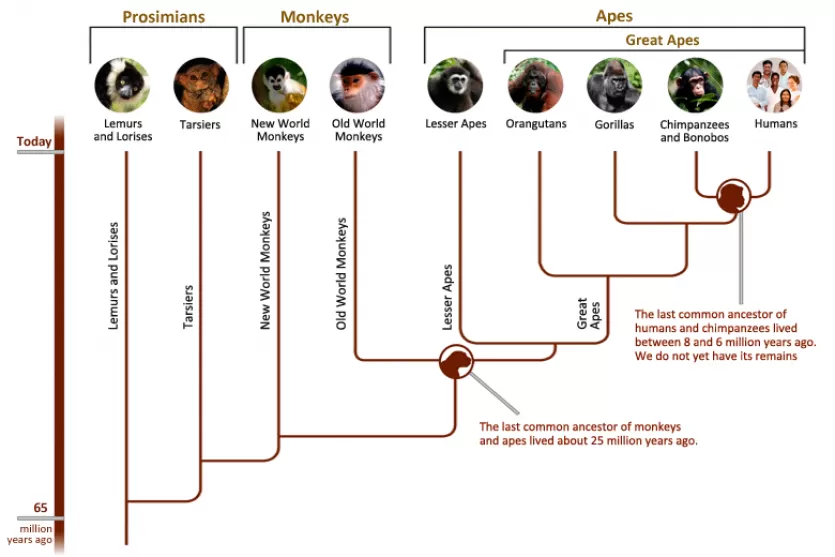
The more closely related two organisms are, the more genetic material they share. Humans are primates and belong to the great apes; our closest living relatives are chimpanzees and bonobos.
During the Paleocene (66–56 mya) and Eocene (56–33.9 mya), Earth was much warmer than today, with forests extending toward the poles and providing extensive habitats for early primates. The Paleocene–Eocene Thermal Maximum (PETM; ~56 mya) brought particularly rapid warming. Earth subsequently cooled, reshaping ape habitats during the Miocene (23–5.3 mya).
Monkeys vs apes - most monkeys have tails; apes do not. Apes generally have larger brains and more flexible shoulders, adapted for climbing and swinging, whereas many monkeys are better adapted for leaping. Hominoids - ape group including gibbons and the great apes. Great apes - orangutans, gorillas, chimpanzees and humans. Anthropoids - all monkeys, apes, and humans.
Timeline
Early primates
- ~66 million-56 million years ago: First primates appear - small, tree-dwelling mammals adapted to forest environments.
- ~56 million years ago: PETM causes rapid global warming, expanding tropical and subtropical forests.
- ~55 million years ago: Archicebus achilles lives in central China - tiny (~20–30 g), tree-dwelling and probably insectivorous; an early relative near the split between tarsiers and anthropoids.
- ~45 million-35 million years ago: Primates diversify into the major lineages leading to modern monkeys, apes and humans.
Rise of the apes
- ~25 million-23 million years ago: Earliest known apes appear in Africa; unlike most monkeys, they lack tails and develop more flexible shoulders and increasingly ape-like body plans.
- ~21 million-14 million years ago: Early apes such as Proconsul, Ekembo, Afropithecus and Nacholapithecus diversify in Africa, becoming larger and increasingly specialized for climbing, while developing more robust jaws and teeth.
- ~16 million-14 million years ago: During a warm period, apes expand from Africa into Europe and Asia, where numerous ape species evolve.
- ~14 million years ago: Global cooling intensifies, fragmenting forests and increasing seasonal variation; ape populations increasingly face more open and seasonal environments.
- ~14 million-12 million years ago: The orangutan (Eurasia?) lineage diverges from the lineage leading to African apes and humans.
- ~14 million-8 million years ago: African ape fossils become unusually scarce compared with Europe and Asia, although this may partly reflect gaps in the fossil record.
- ~13 million-9 million years ago: European apes such as Pierolapithecus and Rudapithecus thrive in forest environments; some develop body plans and locomotor adaptations resembling those of later great apes.
- ~10 million-8 million years ago: Cooling and increasing seasonality reduce European forests, contributing to the disappearance of many European apes and shifting the center of great-ape evolution back to Africa.
Divergence and the human lineage
- ~10 million-8 million years ago: Gorilla (Africa) lineage diverges from the lineage leading to chimpanzees and humans.
- ~7 million-5 million years ago: Human lineage diverges from the lineage leading to chimpanzees and bonobos (Africa).
Gallery
Happening elsewhere at the time
Nothing found.