Middle Roman republic
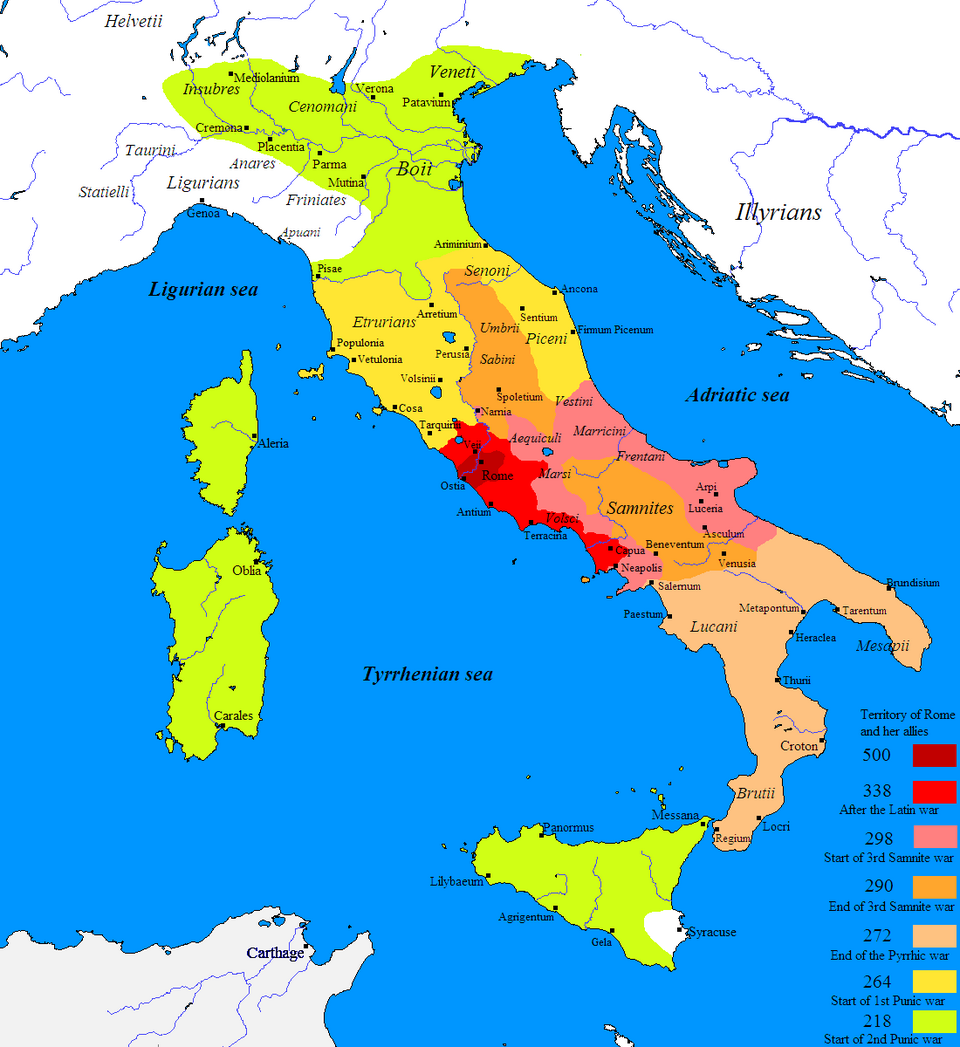
Rome emerged as the dominant power in central Italy, while the political integration of plebeians (consulship + first plebeian censor and dictator) strengthened the Republic. Rome increasingly became involved in neighboring conflicts, with longer wars against stronger opponents and shifting from defending its territory toward deliberate expansion (land, taxation, and manpower).
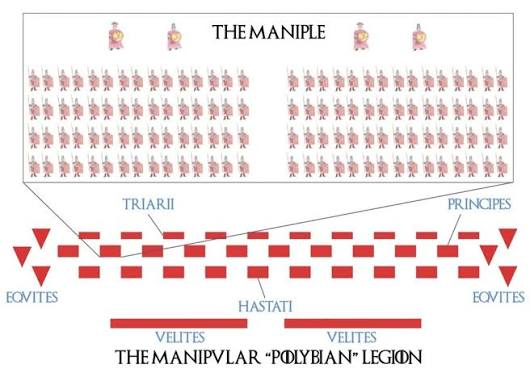
Phalanx was replaced with maniple. The infantry was divided into smaller maneuverable units arranged in three lines. It was combined with light infantry (for beginning skirmish) and cavalry (on sides). Allies had to provide forces, especially cavalry. Soldiers fought with thrown spears before closing with swords. Focus was also on discipline (rewards and punishments), logistics, infrastrucutre (Appian way), fortified camps, and careful planning. The legion consisted of 10 maniples of 120 young, 10 maniples of 120 experienced, and 10 half strength maniples (60) of veterans + 1200 light infantry and 300 cavalry (4500 men in total).
At the end of this period, Rome’s overseas territories included Sicily, parts of Spain, Africa, and Greece, marking the emergence of a more extensive provincial empire. The conquests brought enormous wealth, slaves, and political influence to the Republic, but the benefits were distributed unevenly. Competition among aristocratic families intensified, while changes in landownership and military recruitment placed increasing pressure on traditional republican institutions.
Timeline
First Samnite War
- 343-341 BCE: Rome fought the First Samnite War after becoming involved in the conflict between Campania and the Samnites, semi-nomads from central Apennines (Samnium) who came down from the hills in 300s BC.
- 342 BCE: Plebeian reforms required at least one of the two consuls each year to be a plebeian and ten-year period before a person could hold the same office again.
- ~341 BCE: The First Samnite War ended with Rome having gained the upper hand but without decisively defeating the Samnites.
- ~341 BCE: A mutiny by Roman soldiers in Campania was peacefully resolved by Marcus Valerius Corvus, who secured amnesty for the soldiers.
Latin War
- 340 BCE: The Latin War began after Latin League demanded full Roman citizenship and one of the consuls be from Latin communities.
- 340 BCE: Rome and the Latins fought at the foot of Mount Vesuvius in a closely matched battle, Rome victorious.
- ~340-338 BCE: Rome defeats Latin communities individually (Samnites assisting them), subduing Latium, abolishing Latin league, and granting different degrees of citizenship depending on their conduct.
- ~338 BCE: Roman colonies were established on land taken from communities that had resisted Rome.
Second Samnite War
- 327 BCE: The Second Samnite War began after Rome intervened in Naples at the request of its Greek nobility and expelled a Samnite garrison.
- ~321 BCE: Major Roman defeat at the Caudine Forks after the Samnites trapped their army in a mountain pass, Rome accepts harsh peace terms (according to sources, they didn't accept but could be propaganda).
- ~321-316 BCE: Fighting between Rome and the Samnites paused for ~five years.
- 315 BCE: Major Roman defeat at Lautulae; Campania and other allies threatened to defect.
- 312 BCE: Appius Claudius Caecus began construction of the Appian Way (Rome - Capua), improving movement of troops and supplies into south.
- 312 BCE: Appius Claudius Caecus began construction of an aqueduct to improve Rome's water supply.
- ~312 BCE: Rome replaced the phalanx with the more flexible maniple system due to struggles in the Samnite Wars.
- 311 BCE: The Etruscans entered the war against Rome, opening a second major front.
- 308 BCE: The Etruscans made peace with Rome after their defeat at Lake Vadimo.
- 304 BCE: The Second Samnite War ended with Samnite defeat; Rome founded 13 colonies in Samnium and established garrisons.
- ~304 BCE: Roman citizenship was extended in varying forms to communities across Italy, allowing Rome to integrate defeated peoples while requiring them to provide soldiers.
Third Samnite War
- 298 BCE: The Third Samnite War began after the Samnites resisted further Roman expansion and settlement in Samnium.
- ~297 BCE: The Samnites withdrew and joined forces with the Etruscans against Rome.
- 295 BCE: Umbrians and Gallic tribes from the Po Valley joined the anti-Roman coalition.
- 295 BCE: Rome defeated the coalition at the Battle of Sentinum.
- 293 BCE: Rome defeated the Samnites at Aquilonia.
- 290 BCE: The Third Samnite War ended, leaving Rome dominant across the Italian peninsula.
Pyrrhic wars
- 282 BCE: Rome declared war on Tarentum (Magna Grecia) after a dispute with fleets.
- 280 BCE: Pyrrhus invaded Italy with an army including war elephants (Rome's first battle against them), defeating them at Heraclea.
- 279 BCE: Pyrrhus defeated Rome at the Battle of Asculum, but suffered heavy losses (“Pyrrhic victory”).
- 278 BCE: Pyrrhus left Italy for Sicily to drive the Carthaginians from the island.
- 278-276 BCE: Pyrrhus drove Carthaginian forces back but failing to capture their remaining stronghold.
- 275 BCE: Pyrrhus returned to Italy and was defeated at Beneventum, withdrawing to Epirus.
- 272 BCE: Rome captured Tarentum, completing its conquest of Magna Graecia.
First Punic war
- 289 BCE: After the death of Agathocles, the Mamertines seized Messana.
- 278 BCE: Mamertines joined Pyrrhus's campaign in Sicily against Carthage.
- ~276 BCE: The Mamertines turned against Pyrrhus.
- ~275-265 BCE: Hiero II rose to power in Syracuse.
- 265 BCE: Mamertines requested Carthaginian protection against Hiero II, then Romans to expel Carthaginians.
- 264 BCE: Rome accepted the Mamertines' appeal and sent troops to Sicily, occupying Messana.
- 264 BCE: Carthage sends an army and allies with Syracuse; Rome defeats Syracuse and forces Hiero II to become its ally.
- 262 BCE: Rome besieged and sacked Agrigentum, gaining control of much of southern Sicily.
- 261 BCE: To penetrate Carthaginian strongholds in the west, Rome built its first large fleet, adapting Carthaginian ship designs.
- 260 BCE: First Roman naval disaster; ships under Scipio Asina are captured by Carthaginians.
- 260 BCE: Rome defeated the Carthaginian fleet at the Battle of Mylae using the corvus.
- ~260-256 BCE: The war settled into prolonged, indecisive fighting on land and sea.
- ~260-257 BCE: Carthage uses Sardinia and Corsica as bases to harass the Italian coast.
- 256 BCE: Rome defeated Carthage at Ecnmous and invaded North Africa.
- 255 BCE: Rome defeated at Tunis by Carthaginians reorganized under Xanthippus, invasion abandoned.
- ~255 BCE: The Roman fleet suffered a catastrophic storm while returning from North Africa.
- 249 BCE: Rome attempted a surprise attack on the Carthaginian fleet at Drepana but was defeated.
- ~248-241 BCE: Carthaginian general Hamilcar Barca waged a guerrilla war in western Sicily.
- 241 BCE: Rome defeated the Carthaginian fleet near Sicily; war ended with Carthage surrendering Sicily to Rome and agreeing to pay indemnities.
Between Punic wars
- 241 BCE: A Gallic tribe rebelled against Roman expansion in northern Italy but was defeated.
- 236 BCE: A coalition of Gallic tribes marched south against Rome but dissolved before engaging the Roman army.
- 228 BCE: Rome defeated the Illyrians after their piracy and established a protectorate in southern Illyria.
- 228 BCE: Rome established diplomatic relations with Greeks and was accepted as a political equal, partly to counter growing Macedon.
- 226 BCE: A large Gallic coalition invaded northern Italy, threatening Rome.
- ~225 BCE: Rome defeated the invading Gauls and cleared Gallic forces from Italy south of the Alps.
- 219 BCE: Rome demanded Hannibal ends siege of Saguntum, Carthage rejected; after Saguntum fell, Rome prepared for war.
Second Punic war
- 218 BCE: Rome declared war on Carthage after Carthage refused Rome’s demand to withdraw Hannibal from Saguntum.
- 218 BCE: Hannibal launched his invasion of Italy from New Carthage, crossing from Spain through Gaul with 50k men.
- 218 BCE: Hannibal crossed the Alps with his army and war elephants, suffering heavy losses (25k men survived).
- 218 BCE: Hannibal defeats Romans at Ticinus and Trebia through baits, superior Numidian cavalry and tactics.
- 218 BCE: Hannibal gained support and reinforcements from Gallic groups in northern Italy after his victories.
- 217 BCE: Hannibal crossed the flooded marshes of Etruria, bypassing Roman-controlled roads.
- 217 BCE: Battle of Lake Trasimene - Rome's major defeat after Hannibal ambushed Flaminius's army in the narrow terrain.
- 217 BCE: Hannibal's strategy focused also on encouraging Rome's allies to defect.
- 217 BCE: Quintus Fabius Maximus was appointed dictator and adopted strategy of avoiding battle and refusing baits.
- 217 BCE: Hannibal escaped a Roman trap in Campania by sending oxen carrying torches toward a guarded pass.
- 217 BCE: Marcus Minucius appointed co-dictator alongside Fabius, undermining dictatorship as an office.
- 217 BCE: Minucius attacked and was nearly destroyed; Fabius rescued his army; Minucius accepted Fabius's authority.
- 216 BCE: Battle of Cannae - Hannibal decisively defeated the much larger Roman army through a double-envelopment maneuver.
- 216 BCE: Roman Senate assumed greater control, sidelining popular assemblies and pursuing a more consistent military strategy.
- 216 BCE: Rome raised new legions by changing the minimum/maximum enlistment age and enrolling slaves.
- 216 BCE: After Hiero II died his teenage successor Hieronymus allied with Carthage and began attacking Roman forces in Sicily.
- 215 BCE: Hieronymus was assassinated during a campaign, Carthaginian generals take control over the city.
- 215-212 BCE: The Scipio brothers prevented Carthaginian forces in Spain from reinforcing Hannibal in Italy.
- 211 BCE: Scipios defeated in separate engagements in Spain, ending five years of Roman campaigning there.
- 214-212 BCE: Marcus Claudius Marcellus besieged Syracuse, whose defenses were strengthened by Archimedes' inventions.
- 212 BCE: Rome captured and sacked Syracuse, exploiting a local festival and the defection of pro-Roman nobles.
- 212 BCE: Rome regained control of most of Sicily, securing an important source of grain.
- 215-205 BCE: First Macedonian War — Philip V allied with Hannibal, but Rome supported Greek allies to keep Macedon occupied through raids.
- 216 BCE: Capua defected to Hannibal, becoming the most important Italian city to join the Carthaginian cause.
- 212 BCE: Hannibal captured Tarentum, but the Roman garrison kept control of the coastal citadel, preventing Hannibal from gaining a secure port.
- 212-211 BCE: Rome besieged Capua rather than directly confronting Hannibal, shifting the strategic initiative toward the Romans.
- 211 BCE: Hannibal marched to within ~3km of Rome to force Rome to abandon siege of Capua, but Rome refused and Hannibal withdrew.
- 211 BCE: Capua surrendered to Rome.
- ~211-207 BCE: Rome gradually recovered cities that had defected to Hannibal, and vice-versa.
- 210 BCE: Publius Cornelius Scipio volunteered command of Roman forces in Spain.
- 210 BCE: Scipio captured New Carthage in a surprise assault, releasing Spanish hostages to strengthen alliances.
- 208 BCE: Scipio defeated Hasdrubal in a battle in central Spain, but Hasdrubal escaped left Spain for Italy.
- 206 BCE: Scipio defeated the newly sent Carthaginian army in Spain in Ilipa, Rome now dominant in Spain.
- 207 BCE: Hasdrubal crossed the Alps, hoping to join Hannibal and create a combined army.
- 207 BCE: Battle of the Metaurus - the two consuls secretly combined their armies and defeated Hasdrubal before he could join Hannibal; Hasdrubal was killed in the battle.
- 205 BCE: Scipio authorized to invade North Africa after pitching it to the senate.
- 205-204 BCE: Scipio prepared his invasion force in Sicily and established an alliance with the exiled Numidian prince Massinissa, gaining a crucial source of cavalry.
- 203 BCE: Scipio invaded North Africa with 35,000 troops.
- 203 BCE: Scipio defeated two large Carthaginian armies at two separate battle, leaving Carthage without an effective field army.
- 202 BCE: Carthage recalled Hannibal from Italy.
- 202 BCE: Battle of Zama - Scipio defeated Hannibal. The war ends with Rome victorious.
- 202 BCE: Carthage accepted harsh peace terms, surrendering its overseas territories, its ability to wage war independently, and much of its political independence; Massinissa received an expanded Numidian kingdom.
Wars in the east
- 201 BCE: Pergamum and Rhodes appealed to Rome for help against Philip V of Macedon, whose expansion threatened their territories-
- 200 BCE: Rome issued Philip V an ultimatum to stop his expansion; after he rejected it, Rome began the Second Macedonian War.
- 200 BCE: Roman forces crossed the Adriatic into Illyria.
- 198 BCE: Titus Quinctius Flamininus took command and framed the war as a defense of Greek liberty against Macedonian domination.
- 198 BCE: Greek city-states increasingly supported Rome.
- 197 BCE: Battle of Cynoscephalae - Flamininus defeated Philip V (maniple vs phalanx).
- 196 BCE: Flamininus proclaimed the freedom of the Greek states, but Rome retained influence and expected cooperation and tribute.
- 195 BCE: Tensions grew between Rome and the Aetolian League, which felt excluded from the rewards and hoped to gain greater control over Greece.
- 195 BCE: Roman envoys warned Antiochus III (Seleucid Empire) against intervening in Greece.
- 192 BCE: Antiochus III landed in Greece with a Seleucid force of about 10,000 troops but failed to secure broad Greek support.
- 192 BCE: Rome sent two legions to Greece, where they were joined by the Achaean League against Antiochus and his allies.
- 191 BCE: Battle of Thermopylae - Roman forces defeated Antiochus III’s army.
- 190 BCE: Roman forces under Scipio brothers crossed the Hellespont into Asia Minor.
- 190 BCE: Hannibal defeated by the Rhodian fleet.
- 190 BCE: Battle of Magnesia - Roman and allied forces defeated Antiochus III’s much larger army.
- 188 BCE: Treaty of Apamea - Antiochus III accepted a large indemnity, surrendered territory in Asia Minor, provided hostages, and agreed to keep his forces north of the Taurus Mountains.
- 183 BCE: Scipio Africanus died in retirement at his estate in Campania, embittered by his political treatment in Rome.
- 179 BCE: Philip V of Macedon died after a succession crisis involving his sons Perseus and Demetrius; Perseus became king after persuading his father that Demetrius was conspiring with Rome.
- 172 BCE: Rome sent troops across the Adriatic following growing concern over Perseus’s expansion, diplomatic ties, and suspected involvement in unrest in Illyria.
- 171 BCE: Rome formally declared war on Perseus, beginning the Third Macedonian War; an early Roman defeat encouraged more Greek leaders to support Macedon.
- 171-169 BCE: Roman forces plundered Greek settlements during the campaign, worsening Greek hostility toward Rome.
- 168 BCE: Lucius Aemilius Paullus took command of the Roman army and restored discipline after earlier commanders had allowed extensive pillaging.
- 168 BCE: Battle of Pydna - Paullus defeated Perseus, Perseus captured and taken to Rome, then exiled in Italy.
- 168 BCE: Rome dissolved the Macedonian kingdom and divided its territory into four republics, restricting their trade and preventing them from rebuilding a unified power.
- 167 BCE: Roman forces sacked settlements across Epirus and enslaved a large part of the population as collective punishment following the war, despite Epirus not having been a central participant in Perseus’s conflict.
- 167 BCE: Rome brought Greek hostages to Italy, including the historian Polybius, who later wrote an influential history of Rome and helped explain Roman institutions and expansion to Greek readers.
Mopping up
- 149 BCE: Andriscus led a revolt to reunite Macedon; after initial Roman defeat, Quintus Caecilius Metellus defeated him and made Macedon a province.
- 146 BCE: The Achaean League rebelled against Roman authority; Rome defeated them and destroyed Corinth.
- 151 BCE: Carthage raised an army to defend its territory against Numidian encroachment, violating agreement terms.
- 149 BCE: Rome declared war on Carthage (Third Punic War), and demanded that the Carthaginians abandon their city and relocate inland.
- 149-147 BCE: Roman forces struggled to capture Carthage, with disease and ineffective operations prolonging the siege.
- 146 BCE: Roman forces breached Carthage’s defenses and fought through the city in six days of street fighting before capturing its citadel.
- 146 BCE: Rome destroyed Carthage after its capture; survivors were enslaved or otherwise displaced, and the city was forbidden from being rebuilt.
Gallery
Happening elsewhere at the time
Ancient Rome series
- Origins of Rome
- Kingdom of Rome
- Early Roman republic
- Middle Roman republic
- Late Roman republic